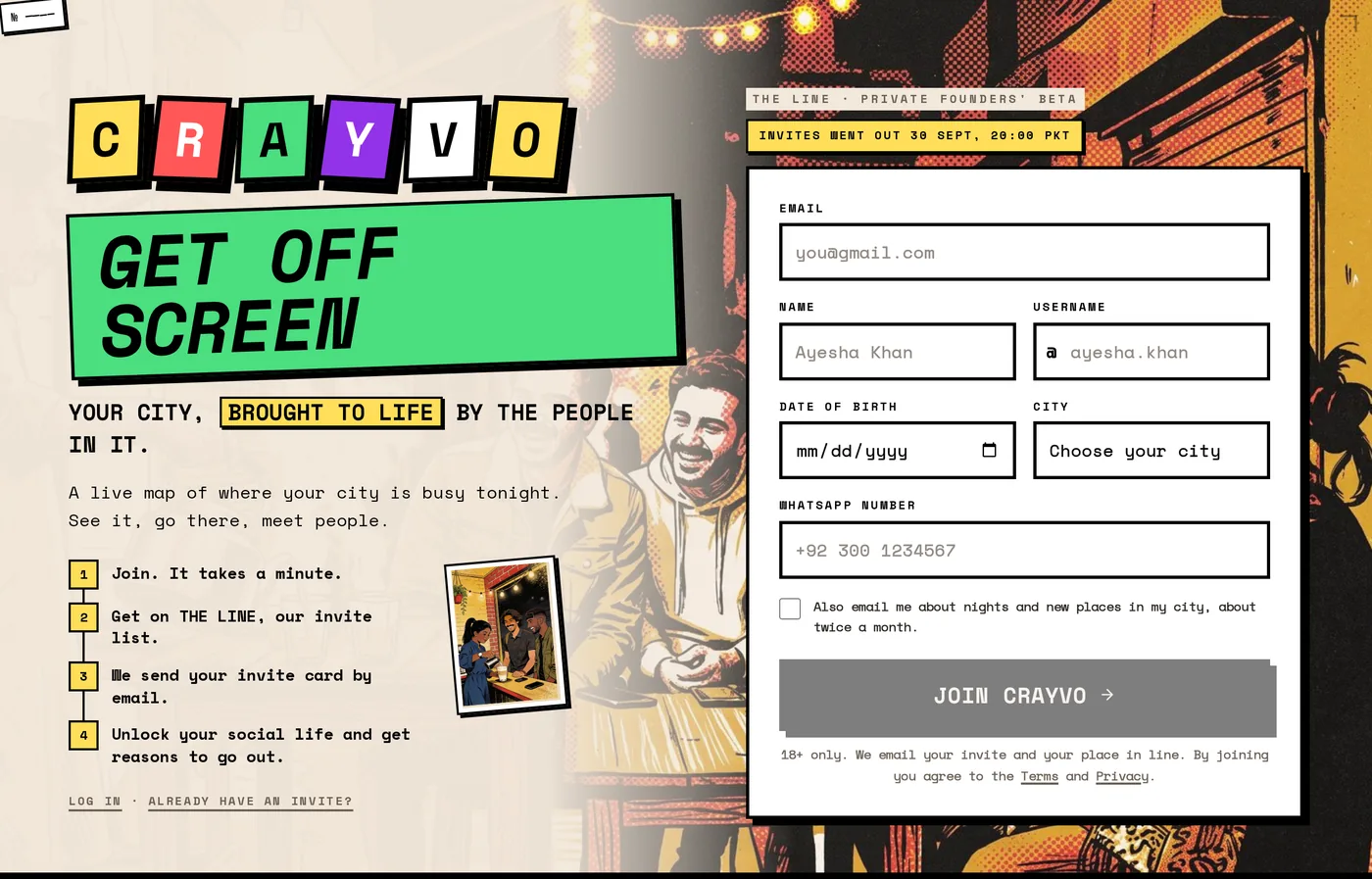
I spent this year building a map. Then I understood that nobody needs another map. What people need is a reason to leave the house, and a friend to leave it with. That is the whole of CRAYVO, and this series is the honest record of building it: what we chose, what broke, and the numbers as they stood on the day I wrote each part.
What it is, for an eight-year-old
Your phone shows you which places in your city are busy tonight and what is happening there: a run club, a comedy night, a market. You pick one, you go, you check in, you meet people. Then you put the phone away. There is no swiping, no profile to polish, no feed to scroll. The app is the door, not the room.
What it is, for an executive
CRAYVO is a consumer product with one loop: discover a night, go, check in, earn, bring a friend. Every number on screen is a real row in our database. Nothing is simulated, seeded or estimated, which is a slower way to build and the only way to earn trust in a product whose promise is "real people, in person."
It opens city by city through an invite list we call THE LINE. Islamabad and Lahore are open. Nine more cities, from Dubai to Seoul, are collecting nights on the web first, because a city page with real nights earns search traffic long before an app earns a download.
The numbers on 4 October
- Eleven cities with public pages: Islamabad, Lahore, Karachi, Dubai, London, New York, San Francisco, Singapore, Paris, Seoul and Colombo.
- 1,124 nights live, each with its own page, its host named and linked.
- 185 of them repeat every week: run clubs, open mics, farmers' markets, board games, life drawing. About a hundred run into 2027.
- 792 more waiting for a person to publish them.
Why "the map is not the point"
A map is a view. A night is a reason. When we put the map first, people admired it and stayed home. When we put the nights first, with the time, the place, the price and the way to the host, the map became what it should be: the thing you glance at on the way out.
That reordering changed the engineering too. The hard problems stopped being rendering and became supply: where do a thousand true nights a month come from, how do you keep them true, and how do you let a program help without letting it lie? That is part 2.